Friday, October 20, 2006

[Negotiation] Chapter 2: Strategizing, Framing and Planning


Essentials of Negotiation.
Chapter 2


This chapter focuses on the key factors which would be necessary to become a successful negotiator.Firstly, the negotiator should select goals. Setting goals are the first step in the negotiation process. The goals set have direct and indirect effects on the negotiators strategy.


Direct effects:


  • Wishes are not goals.


  • Our goals are often linked to the other party's goals.


  • There are limit to what our goals can be.


  • Effective goals must be concrete/specific.

Indirect effects:


  • Forging an ongoing relationship.

Strategy is the overall plan to acheive one's goals in a negotiation. Tactics are short-term, adaptive moves designed to enact or pursue broad strategy. Tactics are subordinate to and driven by the strategy. Planning is the action component of the strategy process.


Per Dual Concerns Model is the option of the strategy which is reflected in the answers to two questions: How much concern do I have in achieving the outcomes at stake in the negotiation? and How much concern do I have for the current and future quality of the relationship with the other party?


Relational outcome important? Substantive outcome important?


No No = Avoidance


No Yes = Competition


Yes Yes = Collaboration


Yes No = Accommodation


Framing is about focusing, shaping and organizing the world around us. They frame people, events and processed differently because people have different backgrounds, experiences, expectations and needs.


Frames are critical because:


  • Negotiators who understand framing may understand how to have more control over the negotiation process.


  • Frames maybe malleable and can be shaped or reshaped during negotiation.


  • Frames shift and change as the negotiation evolves.


Frames as categories of experiances:


  1. Substantive


  2. Outcome


  3. Aspiration


  4. Conflict Management Process


  5. Identity


  6. Characterization


  7. Loss-Gain

Negotiators can use more than one frame. Mismatches in frames between parties are source of conflict. Particular types of frames may lead to particular types of agreements and likely to be used with certain types of issues. Parties may use different frames (Interests, Rights, Power) since there are value differences.


Planning is one of the steps to implement the strategy. Starting from assembling and defining the issues and your interests. You have to know your limits and alternatives, set targets and openings, assess own constituents, analyze the other party, know what strategy and how you want to present and also the protocols need to be followed in this negotiation.

Sunday, October 15, 2006

[Leadership] Chapter 1: Developing Leadership Communication Strategy


Leadership Communication

Chapter 1


Leaders should consider the strategy in communication. In business way, the strategy consists of determining your goals and developing a plan to acheive them. For communication, the same definition is applied. It is to decide what your purpose in communication is and the way to achieve it.


Firstly, you have to clarify your purpose. The purposes for business communication are
  1. To inform-transferring facts, data, or information to someone.

  2. To persuade-convincing someone to do something.

  3. To instruct-instructing someone in a process.


Once you determine your specific purpose, you can begin to come up with the supporting words and ideas and explore your thoughts about the subject. The ways to help you generating ideas are:

  1. brainstorming

  2. Idea Mapping

  3. The Journalist's questions

  4. The Decision Tree


The next essential step is the communication strategy which is the plan to accomplish your purpose. In this step, you have to analyze your audiences and also organize written and oral communication effectively.


[Negotiation] Chapter 1: The Nature of Negotiation


Essentials of Negotiation

Chapter 1


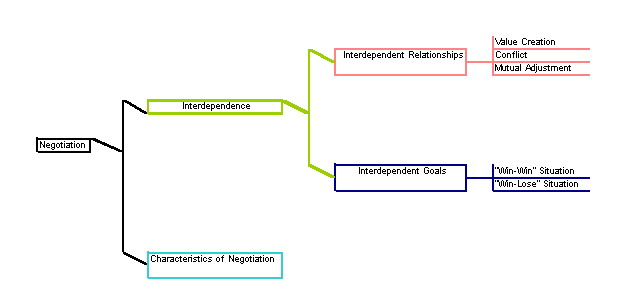
The first chapter is about the nature of negotiation which is something everybody does almost everyday. Negotiation is to create something new that neither party could do on his or her own or to resolve a problem between the parties.


There are several characteristics of negotiation situation:


  • There are two or more parties with conflict of interest between them.

  • The parties negotiate because they think they can use some form of influence to make the solutions best for all parties.

  • The parties prefer to search for agreement rather than to fight openly.

  • In negotiation, we expect to give and take.

  • Successful negotiation involves the management of intangibles as well as the resolving of tangibles.

In negotiation, both parties need each other. Such situation is called "Interdependence".


Two potential consequences of interdependent relationships are value creations and conflict. Negotiation skills are useful in situations where one wants to create value or needs to manage conflict.


There are five major strategies for conflict management have commonly identified: Contending, Yeilding, Inaction, Problem Solving and Compromising.


Welcome!!


Hello everybody!!

This is our blog for BA318 class.
We think this is a great idea to have
a blog so that we all can cantact and help each other
to effectively study this course.

And many thanks to Dr.Sylvia for letting us
learn another way to communicate with people.
We are so sure that learning how to use a blog
will be very useful in the business career in the future.

See you all in class!!

May & Pam